Protection Technologies: Under the Hood
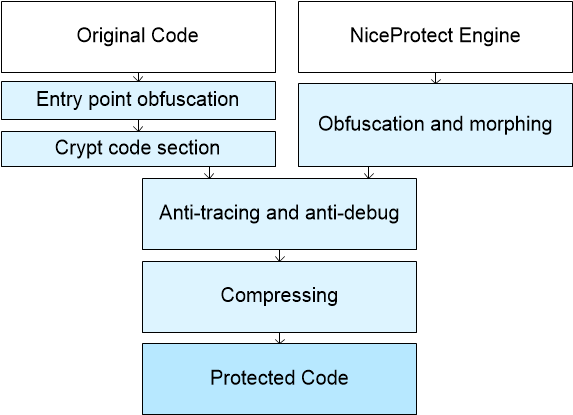
DotFix NiceProtect is not just another packer. It leverages over 20 years of deep research in reverse engineering to provide a multi-layered defense system. Unlike standard protectors that simply modify native assembler code and compress your executable, NiceProtect reconstructs and secures the internal logic of your application using advanced virtualization and unique metadata obfuscation engines.
1. Deep RTTI & Metadata Obfuscation
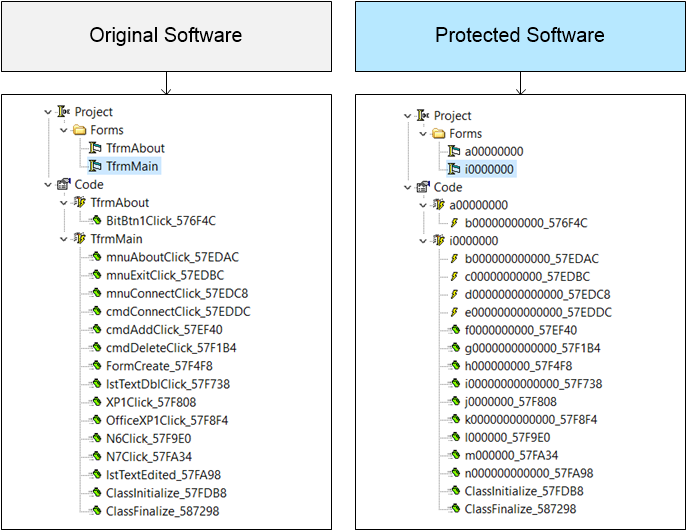
The Exclusive Advantage: Most protectors focus on Assembly code but ignore the high-level metadata embedded by compilers. If you use Delphi (from version 3 to the latest releases, including 12 Athens and future versions), Visual Basic 5.0/6.0, or Free Pascal (Lazarus), your executable contains form names, event handlers, and object hierarchies visible to anyone.
Unmatched Expertise: Our engine is built upon 20 years of R&D behind the famous VB Decompiler and our proprietary, internal-use Delphi decompiler. No other vendor has this level of insight into the internal structures of these compilers.
NiceProtect parses your binary, identifies these structures, and obfuscates them. Meaningful names (e.g., TfrmLicense, CheckSerial_Click) are replaced with random strings, and all internal references are patched. Even if a hacker dumps the process, they see a chaotic structure with no semantic clues.
2. Code Virtualization & Mutation
NiceProtect uses a hybrid approach to secure executable code. You can select functions via a MAP file or mark specific blocks using SDK markers in your source code.
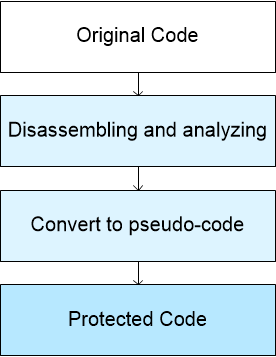
- Virtualization: The engine identifies the linear execution flow of your function (up to the first backward jump or exception handler) and converts it into bytecode for a custom NiceProtect Virtual Machine.
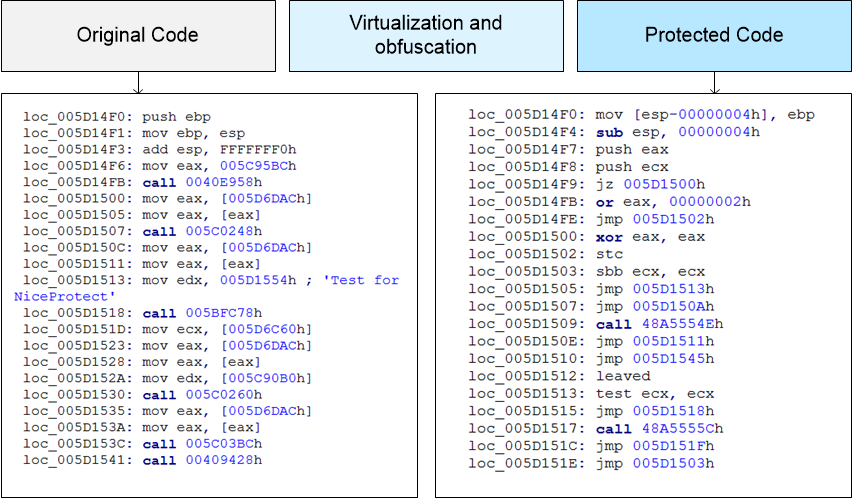
Note: For many linear functions, this means the entire body is virtualized. For complex functions, the critical entry logic (which can consist of hundreds of instructions) is secured, effectively hiding the function's purpose from analysis. Learn more about MAP files for Delphi, Visual C++, or VB6. - Metamorphism: Native instructions are replaced with complex, randomly generated sequences (morphing) that perform the same action but via dozens of different operations.
Why this works: By destroying the standard function entry prologue and turning it into thousands of metamorphic commands, we effectively break the decompiler's ability to reconstruct the function graph. Check the Code Protection guide for details.
3. Multi-Stage Polymorphic Packing
We don't just compress the file; we create a "Matryoshka" (nesting doll) structure that is extremely difficult to unpack automatically. See our Packing Options for configuration details.
- Resource Isolation: Each resource is packed separately with its own unique unpacker.
- Section Packing: Code and data sections are compressed and encrypted.
- Polymorphic Loader: The unpacking stubs and the main loader are generated uniquely every time you protect a file. No two protected files share the same signature.
- Execution Chain: At startup, a polymorphic layer unpacks the main unpacker, which then decrypts the unpacker's of resources and sections. Next, they unpack resources and program sections, and finally passes control to the entry point of the main program code, which is also virtualized to protect against analysis.
This complexity ensures that generic unpacking scripts and automated analysis tools fail to restore the original binary.
4. Additional Security Layers
- Code Section Encryption: The entire code section and the Entry Point are encrypted and only decrypted in memory upon execution.
- Anti-Debugging & Anti-Tracing: The loader includes checks to detect active debuggers. If a trace is attempted, the protection logic will detect the decrease in execution speed and terminate the process, protecting your code from analysis.
- Trusted Signing: Protected files are signed with a digital certificate (based on the IEEE Taggant system or similar trust protocols) generated specifically for your license. This helps verify file integrity and significantly reduces false positives with antivirus vendors.