Protection Options
This section allows you to configure the security layers applied to your application.
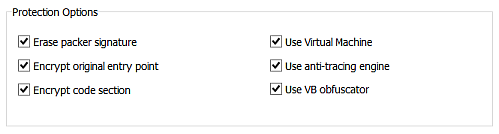
- Erase Packer Signature
Removes signatures of known third-party packers. Use this only if you have pre-packed your application with another tool (not recommended) to prevent automated unpackers from detecting the outer layer.
- Encrypt Original Entry Point (OEP)
Encrypts the initial instructions at the application's entry point, preventing straightforward analysis of the startup code.
- Encrypt Code Section
Encrypts the entire code section of the executable. The code is decrypted in memory only when the application is launched, protecting it from static analysis on disk.
- Use Virtual Machine (VM)
Translates the entry point code (10-500 bytes) into a custom bytecode format. This bytecode is executed by a built-in virtual machine interpreter, making it extremely difficult for attackers to restore the original instructions or identify the OEP.
- Use Anti-Tracing Engine
Injects checks to detect if the application is being traced (stepped through) by a debugger. If tracing is detected, the application's behavior changes to thwart analysis.
- Use VB/RTTI Obfuscator
Enables the metadata obfuscator. This strips or renames human-readable RTTI (Run-Time Type Information) such as form names, event handlers, and unit names in Delphi, C++ Builder, and Visual Basic 5.0/6.0 applications.